I've always loved lighthouses. I'm not particularly sure why; perhaps it was the combination of general family appreciation, their nearness to large bodies of water, and spending a lot of time on Cape Cod when I was young. Anyway, when I was looking for things to do in Maine to break up our road trip to Nova Scotia, lighthouses seemed like an obvious answer. There are apparently 57 active lighthouses in Maine and over 125 in Nova Scotia! (A century ago there were over 170 in Nova Scotia, but many have been lost over the decades.) We ultimately saw five lighthouses in Maine, one in Nova Scotia (as well as a non-lighthouse lighthouse-like structure), and one (not pictured) in New York. Hope you enjoy!
First up, Nubble Light, also known as Cape Neddick Lightstation...
Nubble Light was completed in 1879, electrified in 1938, and automated in 1987.
The keeper's house is of the Victorian era, complete with gingerbread trim.
Although not quite as well known as the Portland Head Light (which we did not get to this trip...next time!), Nubble Light is one of the most often photographed lighthouses in New England.
And from there—on a clear day—off in the distance, you can also see Boon Island Light. At 133 ft (41 m), it's the tallest lighthouse in New England.
Boon Island is a tiny little island about six miles offshore, and the site of many shipwrecks throughout the 17th-19th centuries. Many lighthouses were constructed over the decades, but the one that remains was built in 1954-5.
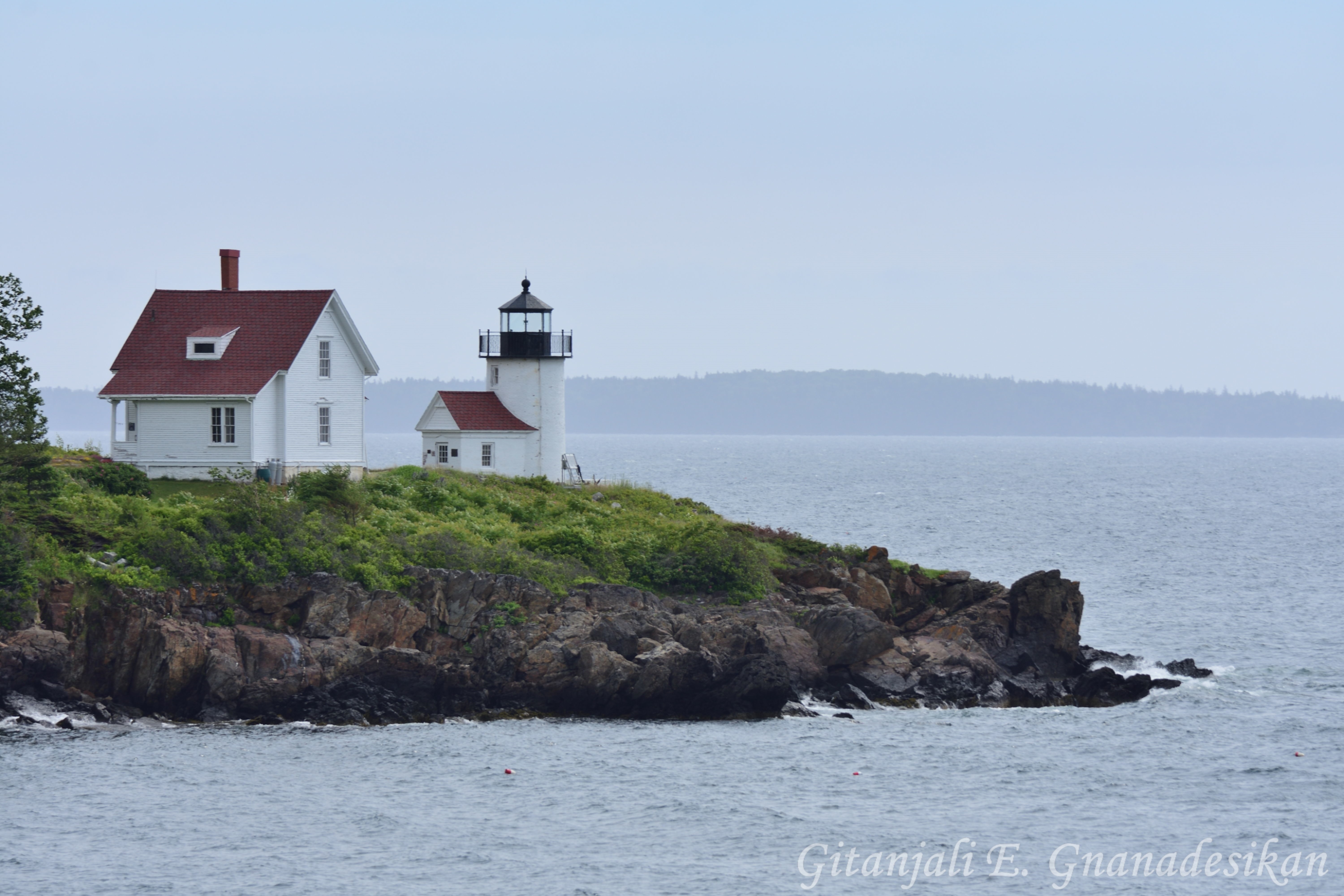
Camden, Maine is a cute little town built around a working harbor, with a remarkable number of old wooden ships. The harbor is sheltered by Curtis Island at its mouth (to the right)...

On the far side of which, overlooking Penobscot Bay, sits the Curtis Island Light.
With the advent of GPS, radar beacons, and other electronic aids, lighthouses have become somewhat (but not entirely) obsolete, and the coast guard has slowly decommissioned and sold many of them.
It's worth noting that although the lighthouse is on the far side of the island, and thus not visible from town, there is a
convenient viewing site (although you can also take a boat out from Camden, if you're so inclined).
As we were sitting there, taking it all in and watching the waterfowl (loon photos coming), suddenly a couple flags peeked out above the lighthouse...
Less than 10 miles to the south is the town of Rockland, which maintains an active port, including ferry service to Vinalhaven, North Haven, and Matinicus. Their breakwater is almost a mile long (you can walk the length of it, although I didn't get the chance this time), with a lighthouse at its furthest point:
Rockland Breakwater Lighthouse. The breakwater itself was built over the years 1880-1890, with the lighthouse added in 1902.
And just a little further south, on the other side of Rockland Harbor, is Owls Head Light.
Owls Head was built in 1852 (replacing one built in 1825) atop a tall bluff, which means the tower itself didn't have to be very tall.
It's only 30 ft (9 m) tall, although the focal height is 100 feet (30 m) above mean sea level!
This lighthouse is not connected to the keeper residence, but is instead up a flight of stairs to the top of the bluff. Apparently, for a few decades in the early 20th century,
there was a covered passageway, but it was removed soon after the light was electrified.
Owls Head still uses a
Fresnel lens (note the texture of the lens panels in the photo below), even though it was automated in 1989. It can be seen for 18 miles!
Between the house and the light, there is a marker for Spot the Lighthouse Dog, who was taught to ring the fog bell and apparently
helped a mailboat steer clear during one particularly blustery storm.
Unlike the rest of the lighthouses, this one is still owned by the Coast Guard.
And has the property tag to prove it!
And as it started raining, we could make out a couple more sailboats in the distance, demonstrating just how helpful a lighthouse would be in such conditions!
We also saw one active light house in Canada, the one in Lunenburg harbor: Battery Point Breakwater Lighthouse. This little light was built in 1951, the third in a line of lighthouses that began up on Battery point in 1864. Here it is as we were leaving the harbor...
And returning (more on the sail itself soon). Yay for solar power!
We also saw this lighthouse-shaped structure, somewhere out by Blue Rocks.
Lastly, unpictured, but spotted from the Tappan Zee bridge: Tarrytown Light. Which I didn't even know existed until reading up about local lighthouses (despite having crossed the bridge many times in my life). I hope to stop and see it on a future trip!