Monday, October 19, 2020

Canyon Lake: In Search of Water

Last month was the anniversary of my cousin's death. My aunt and uncle placed a gorgeous wreath of flowers in the Pacific Ocean, and they encouraged friends and family to place a single flower in any local ocean or river. It was such a lovely idea, especially because my family scattered my grandfather's ashes in Katama Bay just over five years ago. But where was I to find water, here in the Arizona desert? Although there are many local rivers--including one right outside of my apartment--but most of them are seasonally dry (at least in recent years, due to agricultural irrigation water use). Even those running this time of year sadly do not connect to the ocean. So I decided to drive north to the Salt River, a tributary to the Gila River (which runs dry south of Phoenix before it reaches the Colorado River, but at least is a large, relatively natural body of water).


First, I went to find a quiet place to place my orchid flower. There's a lovely canyon to the south of the lake with a small creek. Although there were some families escaping the Phoenix heat in tubes and kayaks near the parking lots, there were also paths through the grass with lots of secluded areas--probably intended for fishing--where it was easy to wade into the water.


After standing for a while in the cool water, I placed the orchid in the water and watched it float off.


A variety of water birds kept me company:

American coot (Fulica americana)

Common gallinule (Gallinula galeata)


Female mallard (Anas platyrhynchos) flying over the common gallinule.

I'm not sure what this one was. Any ideas?

The coot, mallard, and gallinule all together.

And dragonflies...

A lovely rust-orange dragonfly, I think maybe a flame skimmer (Libellula saturata)?


Next, I took a short one-mile hike--a short loop from the Boulder Canyon trailhead--all that I could manage in the 100+ degree heat. But it was worth the lovely views of the lake and canyon. I also spotted a few lizards, some photos of which I might submit to #FindThatLizard.


I love how clearly you can see the line of riparian vegetation along the creek,


On the drive back, I stopped at a few view points the cliffs, which are pretty spectacular, especially due to the yellow coloration in certain places that I believe is due to being covered in lichen:


Despite the heat, it was a lovely, calm day of remembrance, away from work and the rest of the world. 

Sunday, August 16, 2020

Madera Canyon: Escaping the Heat

Yesterday, Tucson hit the 75th day of 2020 with a triple digit high, and we recently had two consecutive days of at least 110°F, which is common here in June, but the first time in August since 1915. At such temperatures, going to elevation is basically the only way to hike--or really spend any time outdoors, except perhaps in a a pool--during daylight hours. So this past week I went back to Madera Canyon for another lovely excursion. I saw many of the same birds, which I could mostly identify this time, plus some new ones! 

I think this is a juvenile elegant trogon (Trogon elegans), which is very exciting, because these birds are rare and highly sought after, as the only member of trogon/quetzal family (Trogonidae) present in the United States. There are a few known nesting pairs in Madera Canyon, but they are mostly found south of the border, in the tropics. The last time I saw a trogon--of a different species--was in Panama!


As is typical of many species, especially birds, the photos you see are often of the brightly colored adult males, while the females and juveniles are much less frequently photographed (or at least shared). It took me a while to identify this one because the barring of the wings seemed so distinctive, but that's not in any of the identifying information for the species. The white spot underneath is mentioned for both juveniles and females though.


Based mostly on the white stripe on the head, I think this one is a female black-headed grosbeak (Pheucticus melanocephalus), which similarly has much more muted coloration than its male counterpart. Unfortunately, she didn't turn her head, so I didn't get a clear side view.


Here's a yellow-eyed junco (Junco phaeonotus) again. There were certain places along the trail where several of these hopped on ahead of me companionably for quite a ways.


This little bird is a house wren (Troglodytes aedon), which is one of the most common and widespread birds in the western Hemisphere. They can be found from Canada to southern Chile, although in the winter they reside closer to the tropics and in the summer some of them migrate polewards.


Mammals tend to be scarcer here in the desert, although I did see a couple of deer and several cute squirrels. Tree squirrels (as opposed to ground squirrels) are much rarer out here than they are back east, and I'm always happy to see them. Also, the local gray squirrel is actually a different species, the Arizona gray squirrel (Sciurus arizonensis), which is endemic to the riparian forests in the sky islands of southern Arizona and northern Mexico.


There were a few different wildflowers blooming along the trail this time, including what I think was a lemon beebalm or lemon horsemint (Monarda citriodora).


These delicate pink flowers are coralbells (Heuchera sanguinea), which are native to Arizona and New Mexico, but are often planted in gardens elsewhere in the country.


My favorite flower of the hike, though, was the Mexican pink (Silene laciniata), which has quite a distinctive lobed petal shape that looks a little bit like a firework.


I didn't see any of them last month, but this time there were several, especially at slightly higher elevation. Here a yellow butterfly of some sort--I think maybe a cloudless sulphur (Phoebis sennae)--is drinking nectar from one. Can you see its tongue (also known as a proboscis)?

I got lucky with the lepidoptera tongues! This one is some kind of skipper. I think maybe it's an Arizona mottled-skipper (Codatractus arizonensis). See the curl of the proboscis in this one?

Sunday, July 19, 2020

In Which Gita Is Entirely Surrounded by Lizards (Dragons)

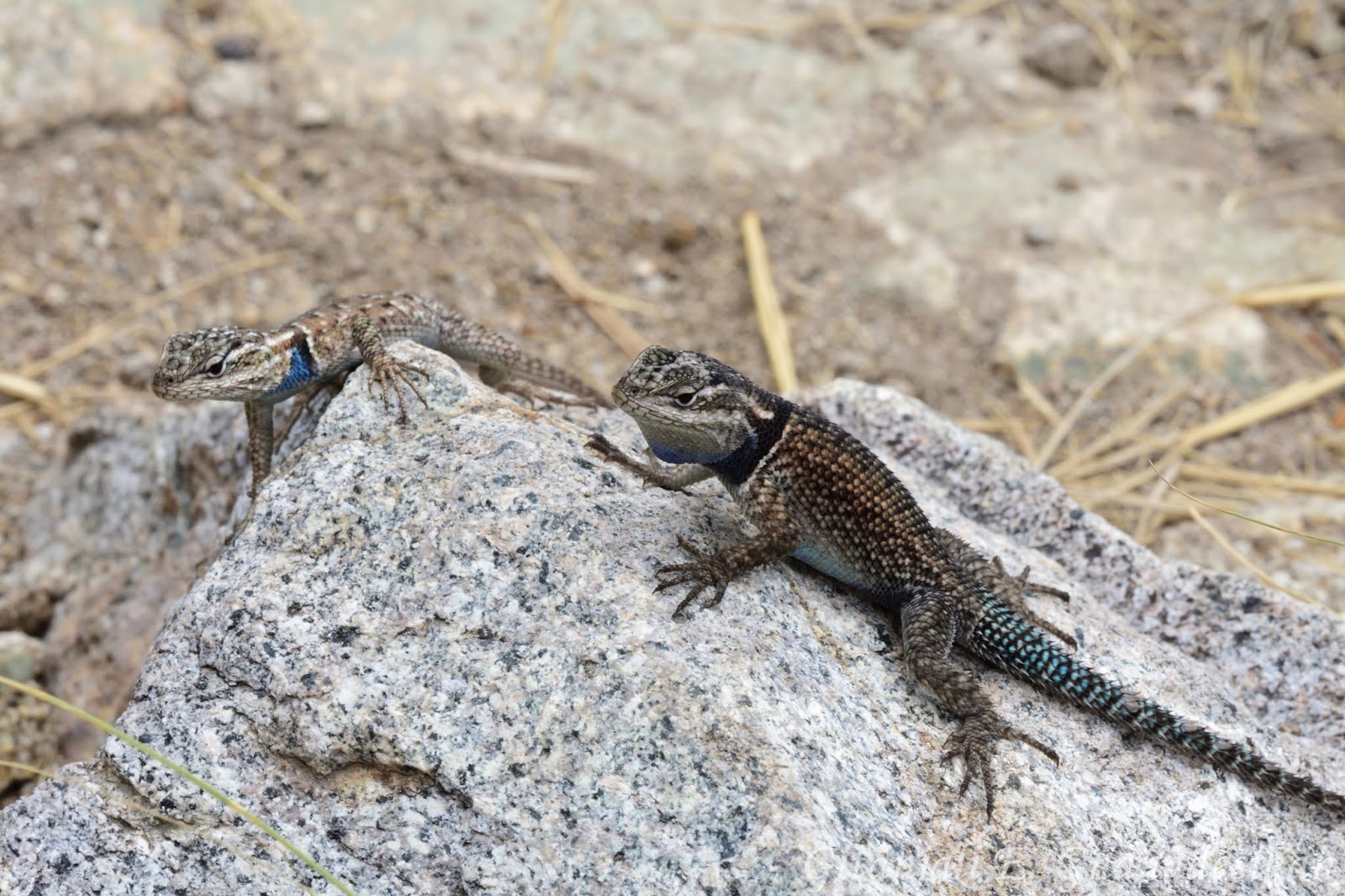
On my hike in Madera Canyon earlier this month, I was rather surrounded by lizards. Mostly, they were Yarrow's spiny lizards (Sceloporus jarrovii), in part because this species is very common in the Sky Islands south of Tucson, and in part because they are not as easily startled as some other lizards, so you're likely to see them. Some of them even stood their ground in the middle of the path until I practically stepped over them.

This has led to the species being relatively well studied among not only herpetologists, but also ecologists, geneticists, and others, including studies of their phylogenetics and species differentiationperception of predators and escape behavior, sexual dimorphismectoparisitism and theromoregulation, predator-prey interactions, and nutritional effects on growth.

One thing that can make lizards difficult to identify is that their coloration, while striking to the observer, is often not the best identifier. There is lots of variation in coloration both among individuals and over time, due to factors such as camouflage, temperature, or hormones, depending on the species. For example, Yarrow's spiny lizards can be quite dark black when they are cold, but become more colorful in the heat, while also exhibiting blue patches that are dependent on testosterone. And gosh were these guys colorful. I thought they looked particularly dragon-like. Yes, I'm aware of how silly that sounds, but given the amount of fantasy I read as a kid, it's a true statement nonetheless.


I love that you can see the side throat patch here that disappears in the next photo.


Peek-a-boo!


These two were having quite the stand-off, and I sat down to watch them for a while.


There are a lot of animals that we're not really used to seeing head on, or at least not in photos, and I always get a kick out of these unusual perspectives.


The throat patch on this one was particularly vibrant (and dragon-like!😂).


Lest my telephoto lens and subsequent cropping give you the mistaken impression that these lizards are larger than they are, here's a zoomed out shot of one of the smaller individuals. Perhaps not quite #FindThatLizard worthy, but not exactly large enough to leap out at you either. It's often their motion that catches the eye.


And the same individual, a bit closer:


This one was clearly comparatively young, probably only a few inches long, and quite adorable.


Alright, that's all for now. Hope you enjoyed these lovely lizards (dragons)!