Saturday, June 20, 2020

Bighorn Fire - Part 2

The Big Horn Fire has now burned over 42,000 acres. That's more than ten times the acreage last week when I posted the first set of photos. While wildfires are common here--the Coronado National Forest estimates an average of 150 fires per year--they are usually much smaller, burning only about 9,000 acres total per year. June is the worst time for wildfires here because it is so hot and dry: the highs these last two weeks have been between 90 and 108°F and there hasn't been any rain.


Here's a map of the fire's spread each day as it has rapidly moved to the northeast, the best visualization I've seen so far:


Approximately 900 people are currently working on controlling this fire, and while the mountainous terrain makes fire-fighting difficult, they've succeeded at keeping it away from houses and populated areas so far. If you're interested, take a look at this remarkable time lapse of the fire progression and preventative measures taken on Mount Lemmon a few days ago. 

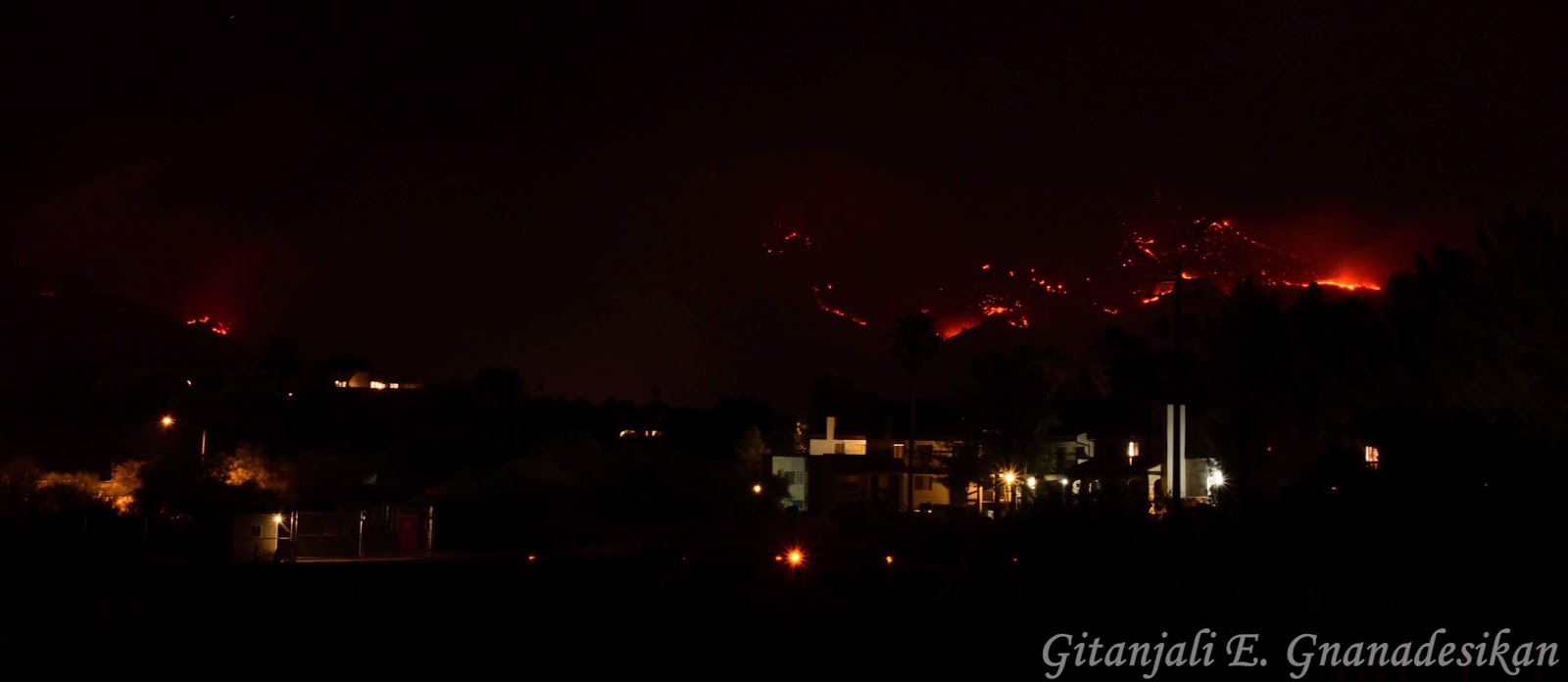
The fire has mostly been burning north of the ridge, such that most of us in Tucson can usually only see the smoke, with the occasional glowing dot somewhere along the ridge. But last night it spilled back over, with visually stunning results.


In the daytime, things look much less apocalyptic, but you can see red swaths of fire retardant in the west, thick active smoke plumes in the east, and lots more smoke blanketing the entire mountain range. 


Thursday, June 11, 2020

The Mountains are on Fire

Never having seen an erupting volcano, I've never seen anything that reminded me so much of Mount Doom as the Catalina mountains covered in wildfire. A lightning strike ignited the Big Horn Fire last Friday, and it's been growing ever since. On Saturday, I first noticed a plume of smoke rising from behind the mountains, then that evening a small portion of the ridge was lit by the glow of the fire. The photos below were taken last night, at which point the fire had spread over more than 3000 acres.

It's a simultaneously beautiful and frightening sight. Wildfires are, of course, a natural and important part of this and many other ecosystems. (Here's a great overview of the importance of natural wildfires, the dangers of fire suppression, and the decisions that go into fire management, written over ten years ago, after the Guthrie Fire.) But as the Big Horn Fire spreads, it's getting closer and closer to people's homes, and evacuations may be starting soon (as if we needed more to worry about right now)*. Nevertheless, from a safe distance the glow of the fire at night is spectacular, and I've never seen anything like it.


*Update: evacuations began this morning. https://www.kold.com/2020/06/11/update-parts-catalina-foothills-being-evacuated-because-back-burn/

Thursday, May 14, 2020

Cactus Blooms and Birds in Saguaro National Park

Having passed my comprehensive exams on Monday, I took a morning to hike in Saguaro National Park (East) this week. It was filled with blooming trees and cacti, as well as a good showing of wildlife, especially birds happily perched atop the saguaros.

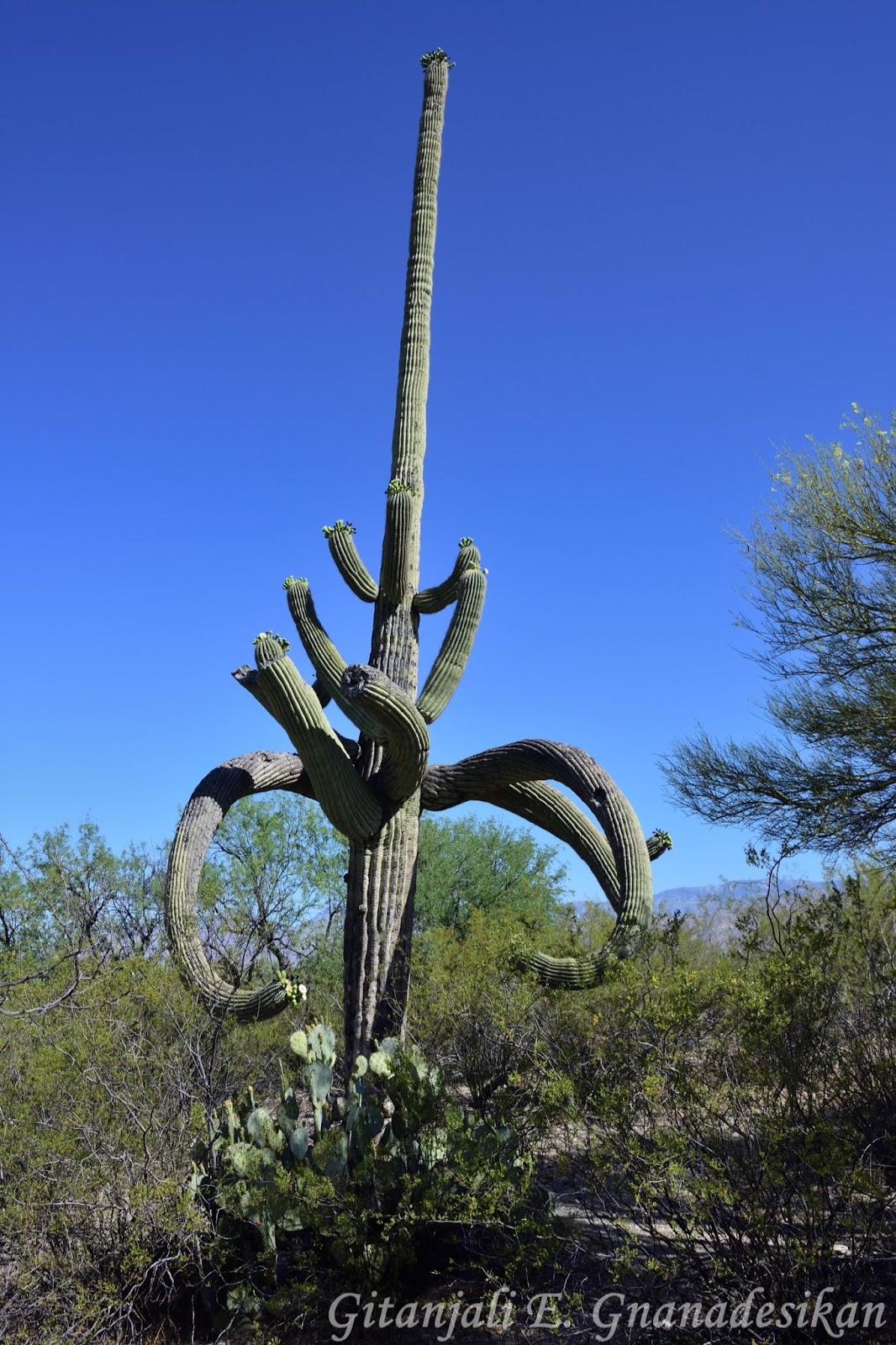
It's the season for saguaro (Carnegiea gigantea) blooms, which I always think simultaneously look gorgeous individually and a little silly in aggregate.


See what I mean? This one was particularly impressive, and the curling arms gave me a better view of the flowers crowning them.


Also in bloom was the brilliant palo verde (genus Parkinsonia), the state tree of Arizona, creating large swathes of yellow throughout the desert landscape.


The mesquite (genus Prosopis) flowers, also a bright yellow, look a little bit like miniature feather dusters.


Various species of cholla (Cylindropuntia) and prickly pear (Opuntia) added additional splashes of color to the scene.


I believe this is Engelmann's prickly pear (Opuntia phaeacanta), the most common prickly pear in Arizona.

Even the cacti fruit contributed to the vibrancy, especially those of the desert Christmas cactus (Cylindropuntia leptocaulis).


We saw a couple ground squirrels, which jumped away quickly with their tails raised adorably, too quickly for me to get a photo, but I did manage to snap a few of this desert cottontail (Sylvilagus audubonii).


The zebra-tailed lizard (Callisaurus draconoides) is one of the easiest lizards to identify out here, due to it's striped tail which it curls up over its body and wags back and forth when it's been disturbed.


The bright coloration of this iron-cross blister beetle (Tegrodera aloga) is quite remarkable and a useful aposematic warning of the cantharidins found inside these beetles. Cantharidin can cause blisters and severe chemical burns if they contact your skin, hence the common name of this entire family of beetles (Meloidae).


Saguaros--often much taller than the surrounding trees--are always a favorite perch for birds, but perhaps even more so when they're blooming. In addition to insects and bats, these birds help with pollination as they fly from cactus to cactus.


I think this cute little guy is a black-tailed gnat catcher (Polioptila melanura).


Some circling turkey vultures (Cathartes aura) were riding the thermals.


 And I'll leave you with one more fun view of a flower-crowned saguaro.


If you can take a moment to get outside for a walk or hike, I highly recommend it! (Even if I did wish I could cool down with a swim afterwards...)