Look at these two large insects that we found on the porch when we came back from class the other day!
Thursday, April 25, 2013
Wednesday, April 24, 2013
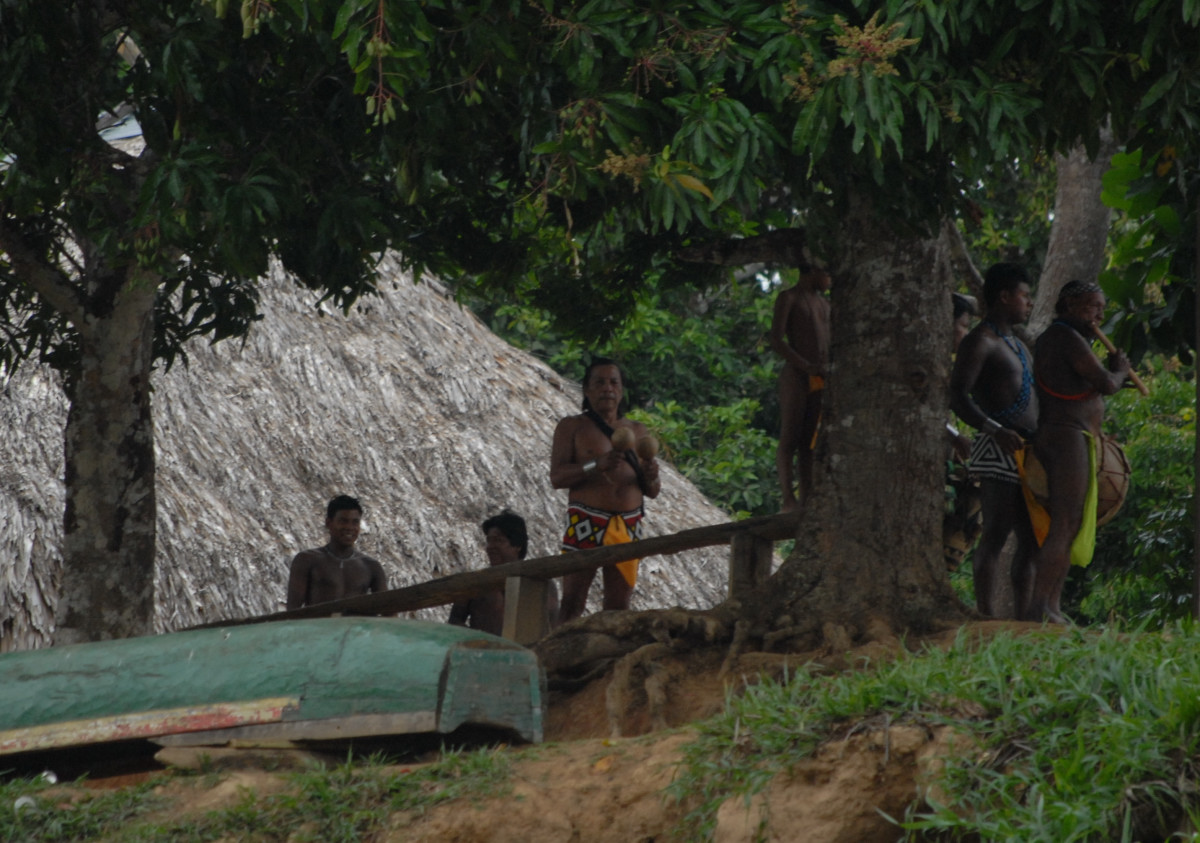
A Visit to the Embera People
On Wednesday we took a field trip to visit a village of one of the indigenous people of Panama, the Embera. The Embera have lived in Darien (the easternmost province of Panama) for hundreds of years at least--their Pre-Colombian history is unclear--but one (extended) family moved westward to make a better life for themselves. They settled along the Upper Chagres River in 1975 and supported themselves with subsistence farming and hunting until 1984 when the watershed became the Chagres National Park. Since 1996, the community has been running its own tourism business. Our visit was a typical tourist visit, but our professor had been visiting this particular village with the class for over ten years and was able to provide some interesting perspective. (She noticed the village in a bit of disarray, asked how things had been recently, and was told there had been a disagreement in the tribe leading to some people, including many of the elders, moving elsewhere.)
We began by journeying up the Chagres River into the forest. We were in traditional dugout canoes, but powered by motors. There was also a man in the front with a long pole, however, to navigate the shallow areas--of which there were many, it being the dry season.
| The view downriver from the point of embarkment. |
| A group of classmates in one of the boats. |
| The man in the front of our boat. (I told you the pole was long...!) |
The river was gorgeous and there were lots of interesting sites and creatures along the way.
| Striated heron (Butorides striata) standing on the shore... |
| Jumping into the air... |
| And flying off! |
| Juvenile Great Blue Heron, dug out canoe in the background. |
| Great Blue Heron on a mission... |
| Lizard! |
| More canoes! |
| An abandoned canoe on the shore. |
| You can see the layers of sediment in the embankment. |
| The river just beneath the village. |
| Interesting rock formations. |
| There were lots of sand bards and logs blocking parts of the river. |
| Musicians welcoming a tourist group. |
| The women wear many beads and bright colors. Originally shell and rock beads and palm cloth were used, now plastic and cloth woven in China and printed in Guatemala. |
| A village. |
| Thatching a roof. |
| Under a thatched roof. |
| Kitchen. They fed us local fish and fried plantains. Yum! |
| Musical instruments. |
They sang traditional songs and danced for us. It was really interesting, but it felt rather strange to be watching them.
| Handmade crafts. |
Each family had a table of crafts. You could tell that some families specialized in certain things: masks, bracelets, wood carvings, etc.
| Woman fixing a headband. |
And most of us got painted tribal tattoos!
Lastly, the tribal medicine man showed us his "pharmacy", that is his forest plots of useful plants.
Saturday, April 20, 2013
Isla Pajaros: Island of the Tropicbirds (and boobies)
One morning in Bocas, instead of going out to do fieldwork, we went on an excursion to Isla Pajaros, home to Red-billed Tropicbirds (Phaethon aethereus) and Brown Boobies (Sula leucogaster).
This part of the island was the domain of the boobies...
Apparently when they are breeding or about to breed, their beaks turn blue. You can sort of see this on the rightmost one here...
And then there are the spectacular tropicbirds...
They have these extremely elongated tail feathers which seem to be a sexually-selected trait serving no other purpose. They certainly look funny in flight curving up and down behind...
And from below, you can see the two tail feathers...
The tropicbirds nest in the crevices on the cliffs of the island.Something about the way they landed struck me as particularly funny. I don't know if it's because of the ridiculously long tail, but they sort of hover with their tail splayed before plopping down into a hole in the cliff.
After sitting and taking pictures of the birds, we jumped out of the boats and snorkeled for a while. We swam through this sea arch...
And around the reef area where there was an octopus! It looked rather like a ball of algae, but hopped along the bottom, reminding me of a rabbit.
When we got back into the boats, we drove around to the other side of the island...
| The other side of the sea arches. |
Which was more exposed to the waves.
And then we snorkeled and collected data in the afternoon! The next day we took a detour on our way to our field site to visit Dolphin Bay where a pod of dolphins lives.
That pretty much wraps up the coral reefs course. We're back in Gamboa now and onto "Precolumbian Peoples of Tropical America and Their Environments."
Subscribe to:
Posts (Atom)
.jpeg)
.jpeg)