Thursday, June 11, 2020

The Mountains are on Fire

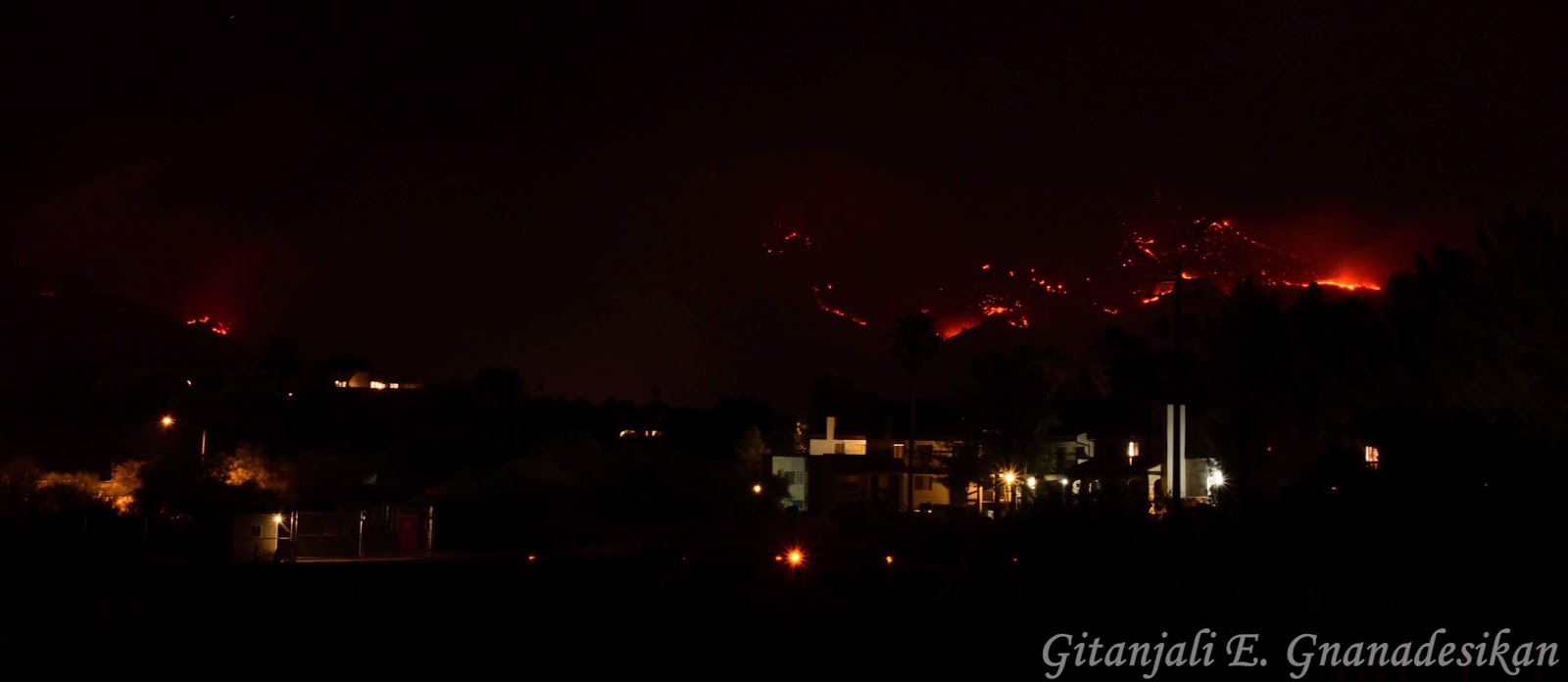
Never having seen an erupting volcano, I've never seen anything that reminded me so much of Mount Doom as the Catalina mountains covered in wildfire. A lightning strike ignited the Big Horn Fire last Friday, and it's been growing ever since. On Saturday, I first noticed a plume of smoke rising from behind the mountains, then that evening a small portion of the ridge was lit by the glow of the fire. The photos below were taken last night, at which point the fire had spread over more than 3000 acres.

It's a simultaneously beautiful and frightening sight. Wildfires are, of course, a natural and important part of this and many other ecosystems. (Here's a great overview of the importance of natural wildfires, the dangers of fire suppression, and the decisions that go into fire management, written over ten years ago, after the Guthrie Fire.) But as the Big Horn Fire spreads, it's getting closer and closer to people's homes, and evacuations may be starting soon (as if we needed more to worry about right now)*. Nevertheless, from a safe distance the glow of the fire at night is spectacular, and I've never seen anything like it.


*Update: evacuations began this morning. https://www.kold.com/2020/06/11/update-parts-catalina-foothills-being-evacuated-because-back-burn/

Thursday, May 14, 2020

Cactus Blooms and Birds in Saguaro National Park

Having passed my comprehensive exams on Monday, I took a morning to hike in Saguaro National Park (East) this week. It was filled with blooming trees and cacti, as well as a good showing of wildlife, especially birds happily perched atop the saguaros.

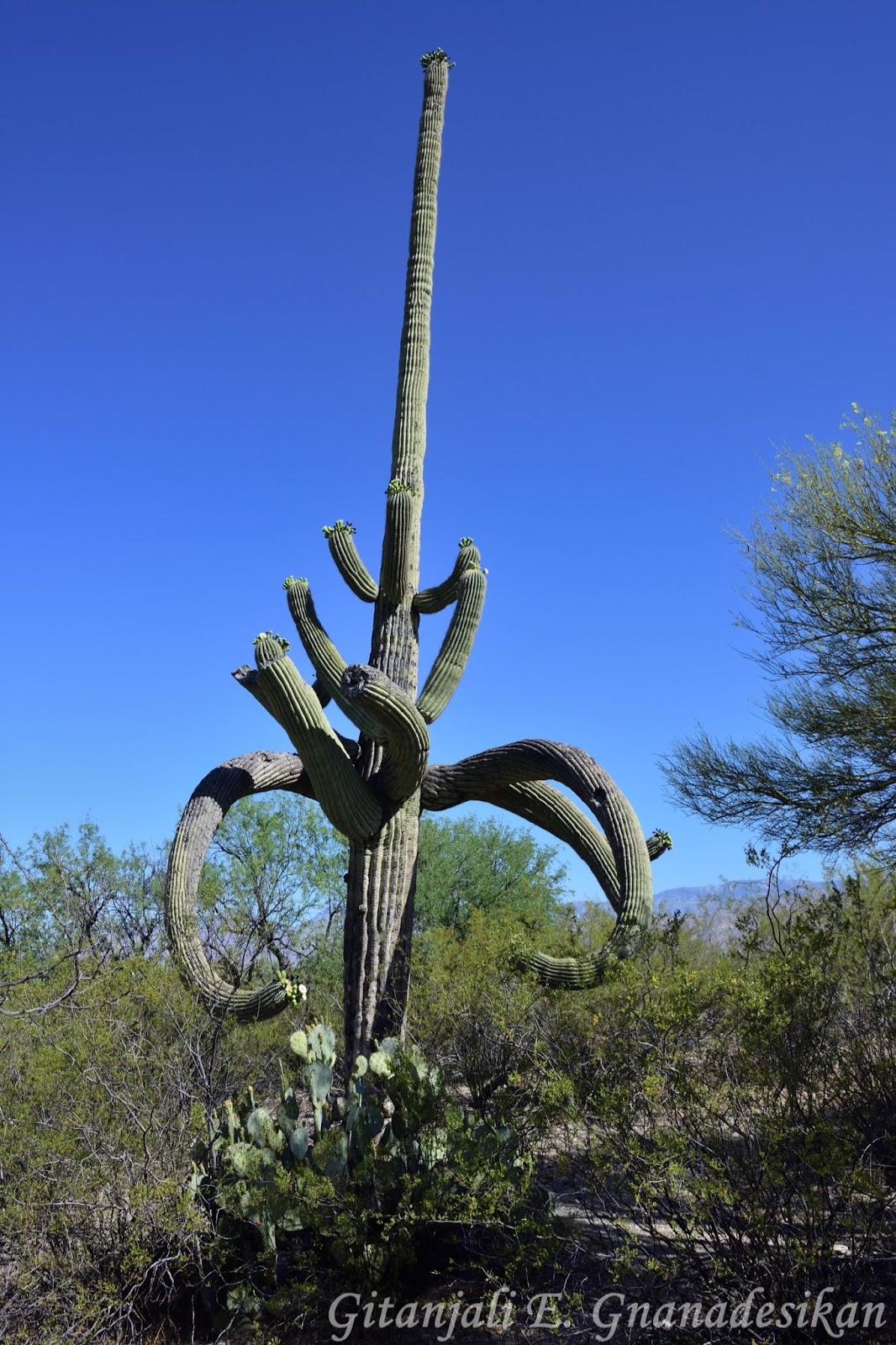
It's the season for saguaro (Carnegiea gigantea) blooms, which I always think simultaneously look gorgeous individually and a little silly in aggregate.


See what I mean? This one was particularly impressive, and the curling arms gave me a better view of the flowers crowning them.


Also in bloom was the brilliant palo verde (genus Parkinsonia), the state tree of Arizona, creating large swathes of yellow throughout the desert landscape.


The mesquite (genus Prosopis) flowers, also a bright yellow, look a little bit like miniature feather dusters.


Various species of cholla (Cylindropuntia) and prickly pear (Opuntia) added additional splashes of color to the scene.


I believe this is Engelmann's prickly pear (Opuntia phaeacanta), the most common prickly pear in Arizona.

Even the cacti fruit contributed to the vibrancy, especially those of the desert Christmas cactus (Cylindropuntia leptocaulis).


We saw a couple ground squirrels, which jumped away quickly with their tails raised adorably, too quickly for me to get a photo, but I did manage to snap a few of this desert cottontail (Sylvilagus audubonii).


The zebra-tailed lizard (Callisaurus draconoides) is one of the easiest lizards to identify out here, due to it's striped tail which it curls up over its body and wags back and forth when it's been disturbed.


The bright coloration of this iron-cross blister beetle (Tegrodera aloga) is quite remarkable and a useful aposematic warning of the cantharidins found inside these beetles. Cantharidin can cause blisters and severe chemical burns if they contact your skin, hence the common name of this entire family of beetles (Meloidae).


Saguaros--often much taller than the surrounding trees--are always a favorite perch for birds, but perhaps even more so when they're blooming. In addition to insects and bats, these birds help with pollination as they fly from cactus to cactus.


I think this cute little guy is a black-tailed gnat catcher (Polioptila melanura).


Some circling turkey vultures (Cathartes aura) were riding the thermals.


 And I'll leave you with one more fun view of a flower-crowned saguaro.


If you can take a moment to get outside for a walk or hike, I highly recommend it! (Even if I did wish I could cool down with a swim afterwards...)

Thursday, March 19, 2020

Taking a Day Off: Hiking, Wildflowers, and Woodpeckers

I worked straight through spring break to meet a deadline, move forward on research projects, and prepare for family being in town this week (now cancelled), so yesterday I finally took the day off and went for a hike in Catalina State Park. It felt good to get out and moving about. And it was a great hiking day, cloudy and not too warm, with wildflowers starting to appear. They're not as spectacular as last year's (yet?) and clearly still shy of full bloom, but all the color was gorgeous. Also I first heard, then saw, and eventually identified a new (to me) bird, the ladder-backed woodpecker!


The owl clover (Castilleja exserta) was out in full force already.


None of the California poppies (Eschscholzia californica) were open yet, but they were still bright and beautiful.


The lupines, of course, were lovely, as always. I believe these are mostly desert lupine, also known as Coulter's Lupine (Lupinus sparsiflorus), one of the most common lupines around here (although there are at least 25 species of lupine in Arizona, so I'm not promising anything!).


This silverpuff (Uropappus lindleyi) has a distinctive shape, courtesy of its pointed bracts.


And this little yellow flower is known as a California suncup (Eulobus californicus).


A common shrub in these parts, this hopbush (Dodonaea viscosa) caught my attention because it's redder than most. What look like flowers are actually fruit.


Arguably it was the creamcups (Platystemon californicus) that really stole the show. They're hard to see here because they're tiny and haven't yet opened into full blooms, but they densely covered large areas beside the trail.


Here's a close up. Before the buds have opened they're all fuzzy, then the petals emerge, and next they will fully bloom.


Perhaps the most surprising plant of the day, though, was the wild cucumber, also known as Gila manroot (Marah gilensis). They're spiky and adorable (but not edible).


Here are a few views of the surroundings.


More flowers! How many species do you see here?


I see at least poppies, lupines, owl clover, desert chicory (the white ones in the background), and some small purple ones that are blurry (sorry!), but that I think might be distant scorpionweed, also known as wild heliotrope (Phacelia distans). 

And now for the animals. I think this might be either a painted lady (Vanessa cardui) or a west coast lady (Vanessa annabella).


Here's the female ladder-backed woodpecker I was mentioning before. While many woodpeckers have barring on their feathers, the even striping here is quite distinctive, hence the name.


And just near the end of the hike, this cardinal made its colorful appearance.


That's it for now! I hope if you're somewhere where you can safely get outside you do so. I know I felt a whole lot better for it. And regardless, I'd love to hear from you and hear how you're doing. Send me an email or text, or even give me a call!